This post may contain affiliate links so we may receive compensation if you sign up for or purchase products linked to below. As an Amazon Associate, I can earn from qualifying purchases. Read our affiliate disclosure for more information.
Most people searching “best fashion walking shoes” want a shoe that looks intentional with everyday outfits, but still holds up for real mileage: commutes, errands, travel days, conferences, museums, and city weekends. The mistake is assuming “cute sneaker” and “walking shoe” are interchangeable. They are not.
A fashion walking shoe is the overlap of three things:
First, walk geometry that reduces fatigue. Look for a stable platform, a predictable heel-to-toe transition, and enough cushioning to damp sidewalk impact (especially if you’re doing 8,000–15,000 steps). Rocker designs can help many walkers roll forward more smoothly.
Second, fit and foot mechanics that don’t punish you later. You want a snug heel (no slipping), room to wiggle toes, and about half to a full thumb’s width from longest toe to the end of the shoe. This is basic, but it’s also where most “blister stories” start.
Third, styling that reads “outfit-ready,” not gym-only. Clean lines, controlled proportions, and materials that don’t collapse visually (leather, structured mesh, suede overlays) matter as much as comfort.
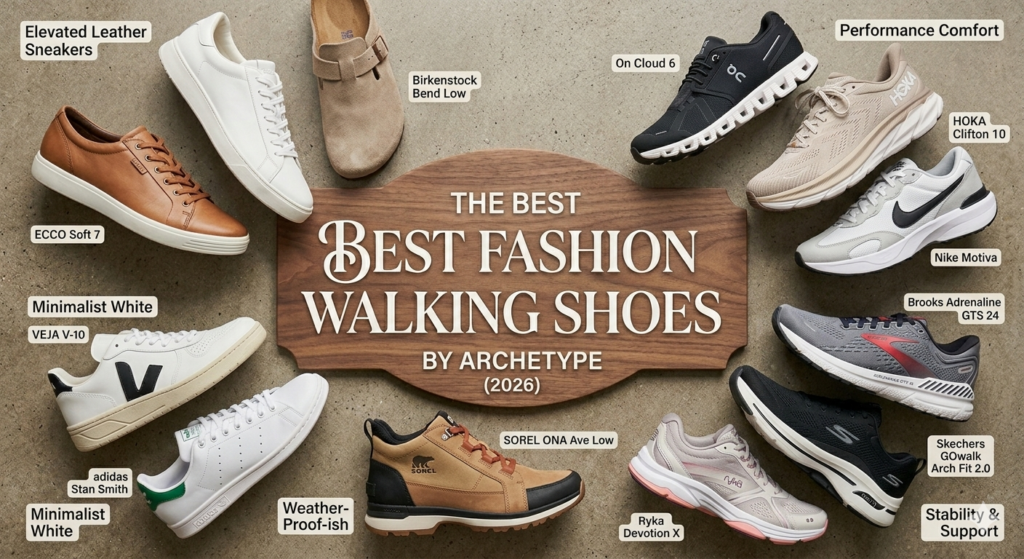
The short list: the best options by style archetype
Below are picks that are consistently strong for comfort-per-mile while still being wearable with real outfits. I’m intentionally mixing performance brands (for biomechanics) with premium casual brands (for styling), because that is the real-world solution.
Elevated leather sneakers that still walk well
ECCO Soft 7 (best overall “quiet luxury” walking sneaker)
It’s one of the rare leather sneakers that is genuinely built for all-day wear, not just looks. The removable insole is practical if you use orthotics, and the leather upper keeps the silhouette clean with trousers, denim, and dresses.
Pros: premium materials, refined look, removable insole, high review volume.
Cons: less “springy” than modern foams; leather can feel warm in hot climates.
Cole Haan GrandPrø Topspin (best “dress sneaker” that stays light)
A good bridge shoe when you want something that can pass in business-casual settings but won’t feel like a brick on a long day.
Pros: lightweight feel, clean profile, easy to dress up.
Cons: typical tradeoff is less underfoot structure than true walkers; outsole grip varies by version.
Birkenstock Bend Low (best “footbed-first” fashion sneaker)
If you like the Birkenstock idea (supportive footbed) but want it in sneaker form, this is the vibe.
Pros: supportive footbed concept, minimalist styling.
Cons: you’ll either love or hate the firmer feel; break-in can be real.
Minimalist “white sneaker” looks that won’t betray your feet
VEJA V-10 (best fashion-forward white sneaker that can travel)
This is a style staple and photographs well. For many people, it’s comfortable enough for city days, especially with a swap-in insole if needed.
Pros: elevated casual style, strong “wardrobe versatility,” good ratings in the listing shown.
Cons: not a high-cushion walking platform; if you’re doing 15k steps daily, you may want more midsole.
adidas Stan Smith (best iconic clean sneaker)
It’s timeless and pairs with almost everything. It can work for walking if your feet are tolerant and you size correctly.
Pros: classic silhouette, widely available, easy styling.
Cons: it is not engineered as a walking shoe first; many people benefit from a better insole.
Performance-walking comfort that still looks good with outfits
On Cloud 6 (best “sleek travel sneaker” look)
On tends to nail the “athletic but not loud” aesthetic. Good for airport days, conferences, and “walk a city all day but still look put together.”
Pros: lightweight vibe, strong consumer ratings in the listing shown.
Cons: some people dislike the specific underfoot feel; durability and traction depend on model and surfaces.
Nike Motiva (best pure walking mechanics for the money, still wearable)
This is one of the more walking-specific mainstream options, and the rocker design is explicitly aimed at smooth transitions.
Pros: walking-focused rocker, roomy forefoot/arch/toe box callouts, high ratings.
Cons: rocker shoes feel weird to some at first; styling is sportier than leather classics.
HOKA Clifton 10 (best “cushion all day” shoe that’s now mainstream-fashion adjacent)
HOKA’s maximal cushioning has become normal in street style, and the Clifton line is a go-to for people who want to protect legs and feet on high-step days. Podiatrist-driven roundups frequently emphasize cushioning and support as a practical reason to upgrade worn-out shoes.
Pros: high cushioning, strong popularity and reviews in the listing shown.
Cons: maximal midsoles aren’t as sleek; some people find them too soft.
If you need stability, pronation control, or you get foot pain
Brooks Adrenaline GTS 24 (best stability “guardrails” style support)
If your feet collapse inward, or you get knee/arch/heel complaints after long days, stability design can be the difference between “fine” and “hobbling.”
Pros: stability-focused build, widely used for support, strong review base.
Cons: not the sleekest; stability shoes can feel “structured” if you prefer a free, flexible ride.
Skechers GOwalk Arch Fit 2.0 (best easy slip-on support)
This is the “be comfortable immediately” play, especially if you want slip-in convenience with arch support positioning.
Pros: comfort tech + arch support framing, convenience, strong rating in the listing shown.
Cons: styling is more casual; long-term midsole resilience can vary by wearer and mileage.
Ryka Devotion X (best women-specific walking fit)
Ryka focuses heavily on women’s foot shape and walking use-cases. This is a strong “purpose-built walking sneaker” that still has enough styling to not look purely gym-only.
Pros: walking-first design, high review volume in the listing shown.
Cons: aesthetics lean athletic; materials can look less premium than leather options.
Weather-proof-ish style (wet sidewalks, shoulder seasons)
SOREL ONA Ave Low (best “street sneaker” with wet-day practicality)
If your version of walking includes wet days, you want traction and materials that won’t instantly look ruined.
Pros: street-ready style, described waterproof/seam-sealed build in the listing shown, good for transitional weather.
Cons: less airy; can feel warmer and heavier than mesh runners.
How to choose the right pair, step by step (this is where you win)
step 1: decide which of the four “walking shoe profiles” you are
- style-first, moderate steps (3k–8k/day): leather sneaker profile (ECCO, Cole Haan, VEJA, Stan Smith).
- travel and city steps (8k–15k/day): sleek performance profile (On Cloud 6, Nike Motiva, HOKA Clifton).
- support needs (flat feet, pronation, recurring pain): stability/support profile (Brooks Adrenaline, Skechers Arch Fit, Ryka).
- weather or mixed surfaces: traction/material profile (SOREL).
step 2: fit rules that matter more than brand
A practical fit test beats marketing every time:
Heel must be snug with no slippage. If it slips in-store, it will slip when you sweat and swell.
Toe box should allow toe wiggle, and leave roughly half to a full thumb’s width in front of the longest toe.
Try shoes later in the day when feet are slightly swollen, especially if you’re buying for travel.
step 3: the five build features that separate “cute sneaker” from “walking shoe”
If you want a fast, high-signal checklist, use this:
A firm heel counter (squeeze the back; it shouldn’t collapse).
A stable midsole (not twisty like a towel).
Enough cushioning for your surfaces (concrete needs more than treadmill).
A toe box that matches your foot shape (bunions need width and soft uppers).
A predictable heel-to-toe transition (rocker designs help some walkers a lot).
If you deal with heel pain or plantar symptoms, clinician-oriented guidance often emphasizes supportive arches, firm heel counters, and rocker or stable transitions as features worth prioritizing.
Outfit strategy: how to make walking shoes look expensive
If your goal is “fashion walking shoes,” styling is not optional. Here’s the playbook that consistently works:
Keep the palette controlled. White, off-white, black, or a single accent color reads intentional.
Match shoe bulk to pant hem. Chunkier shoes (HOKA) look better with wider-leg pants, cargos, or straight denim; slimmer shoes (ECCO, Stan Smith) work with tapered trousers and dresses.
Upgrade the socks. Invisible socks often look sloppy; a clean crew sock can look editorial.
Protect the uppers. A basic protectant spray for suede/leather is a high-ROI move if you care about aesthetics.
Pros and cons: fashionable walking shoes as a category
Pros: you actually wear them, which means you walk more, travel easier, and your cost-per-wear plummets.
Pros: a great pair can replace multiple niche shoes (errands, commute, casual dinners, travel days).
Pros: modern “athleisure normalization” means cushy shoes no longer look out of place.Cons: truly sleek silhouettes rarely have the best biomechanics for 15k-step days; you often trade appearance for midsole performance.
Cons: the internet overuses the word “supportive,” and many shoes are just soft, not stable.
Cons: comfort can drop sharply after the foam packs out; high-step users should plan for replacement cycles.